

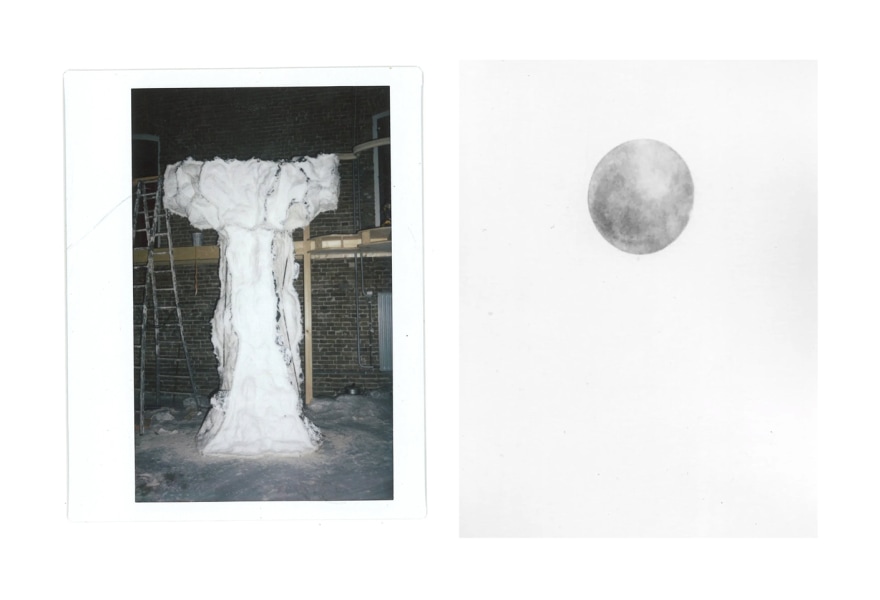
At Fred & Ferry, the gallery is divided into two exhibitions. The photographs by Jana Coorevits and sculptures by Krystel Geerts may seem very different at first glance, yet they share a common sensitivity, as they allow the subject matter to seek its own form by giving it attention and observing what emerges.
Jana Coorevits (b. 1990) and Krystel Geerts (b. 1993) focus on process, guided by a curiosity rooted in ‘not knowing’. The outcome is never fixed. In Coorevits’ work, an image gradually emerges through repetition, reversals and contact prints, while Geerts creates form through a physical struggle with clay in which traces of labour, emotion and resistance are embedded. In the work of both artists, meaning is not a given, but something that arises in the process between maker, material and time.

Jana Coorevits
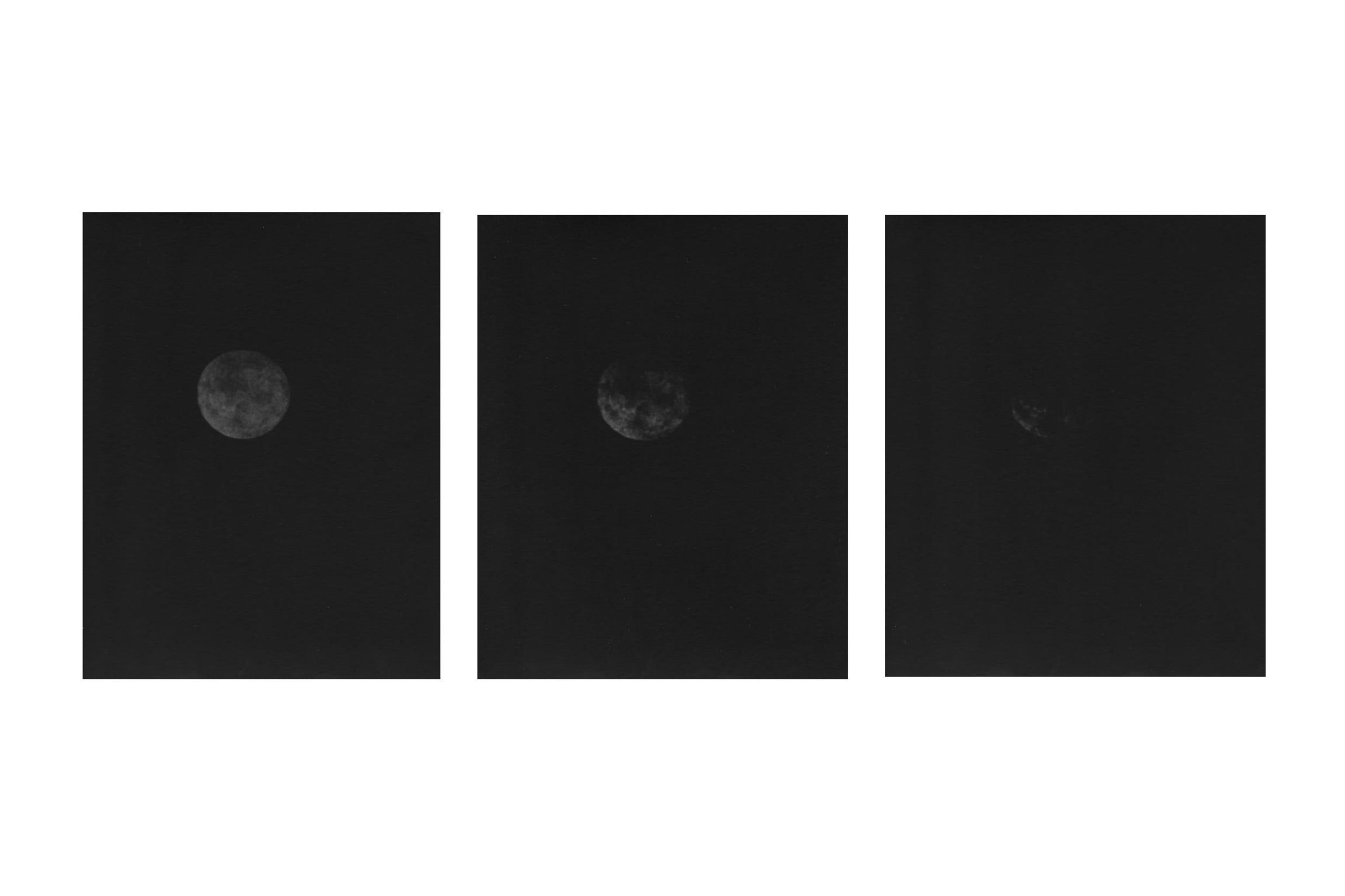
From this shared sensibility, two exhibitions unfold in which images are presented without explanation. Jana Coorevits’ work stems from a radical form of attention. “For several years, I focused on the moon,” she explains. “I made analogue recordings using photography and video repeatedly at different locations and at different times. Through repetition, I have delved deeper into the materiality of the image. In the darkroom, I began to reinterpret the moon and explore what is concealed within the image.” The moon functions as a gateway. It is a constant presence that allows her to look, orient herself and slow down.
Jana Coorevits, luchtvlak landschap zon, maan, Fred & Ferry
In the rear room of the gallery, Coorevits presents four series of contact prints, each of which starts with a different photograph of the moon. With every reversal, the image shifts. Coorevits deliberately chose the same parameters in terms of exposure time, method and repetition. What changes is what the material itself reveals. In some cases, the moon disappears entirely or evolves into unusual distortions, such as an increasingly flattened ellipse. “I want to continue this series. I’m curious to see how it will evolve,” she says. In some contact prints, elements suddenly surface that were latently present, such as fibres, a tear in the paper or notes on the reverse. The paper, emulsion and light are active agents in the images, which come into being through an interplay between maker, material and time. What becomes visible is unpredictable in a process that involves unfolding, disappearing and reappearing.
Krystel Geerts
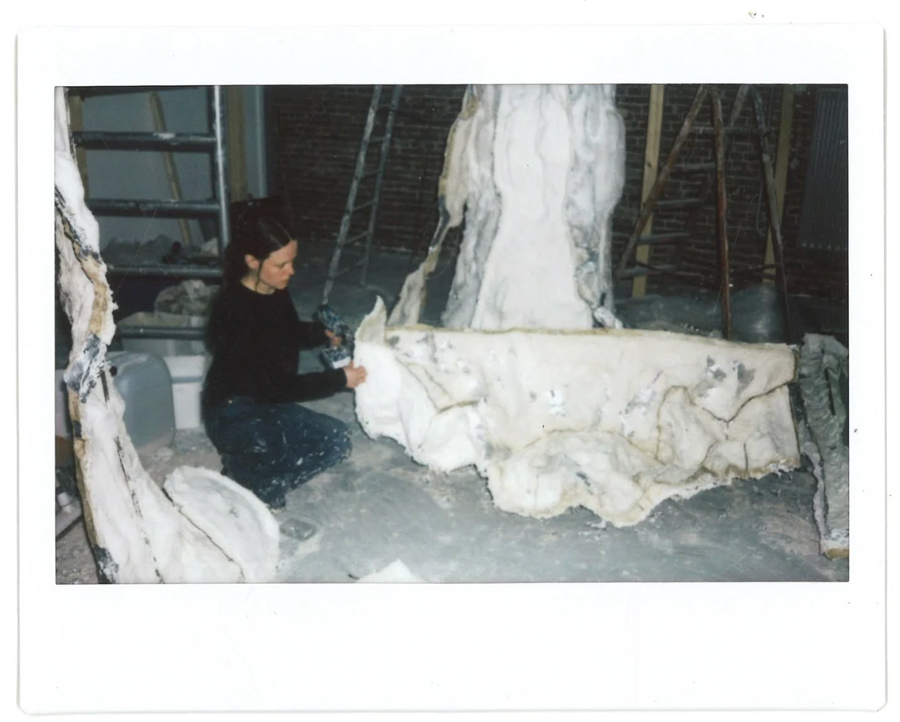
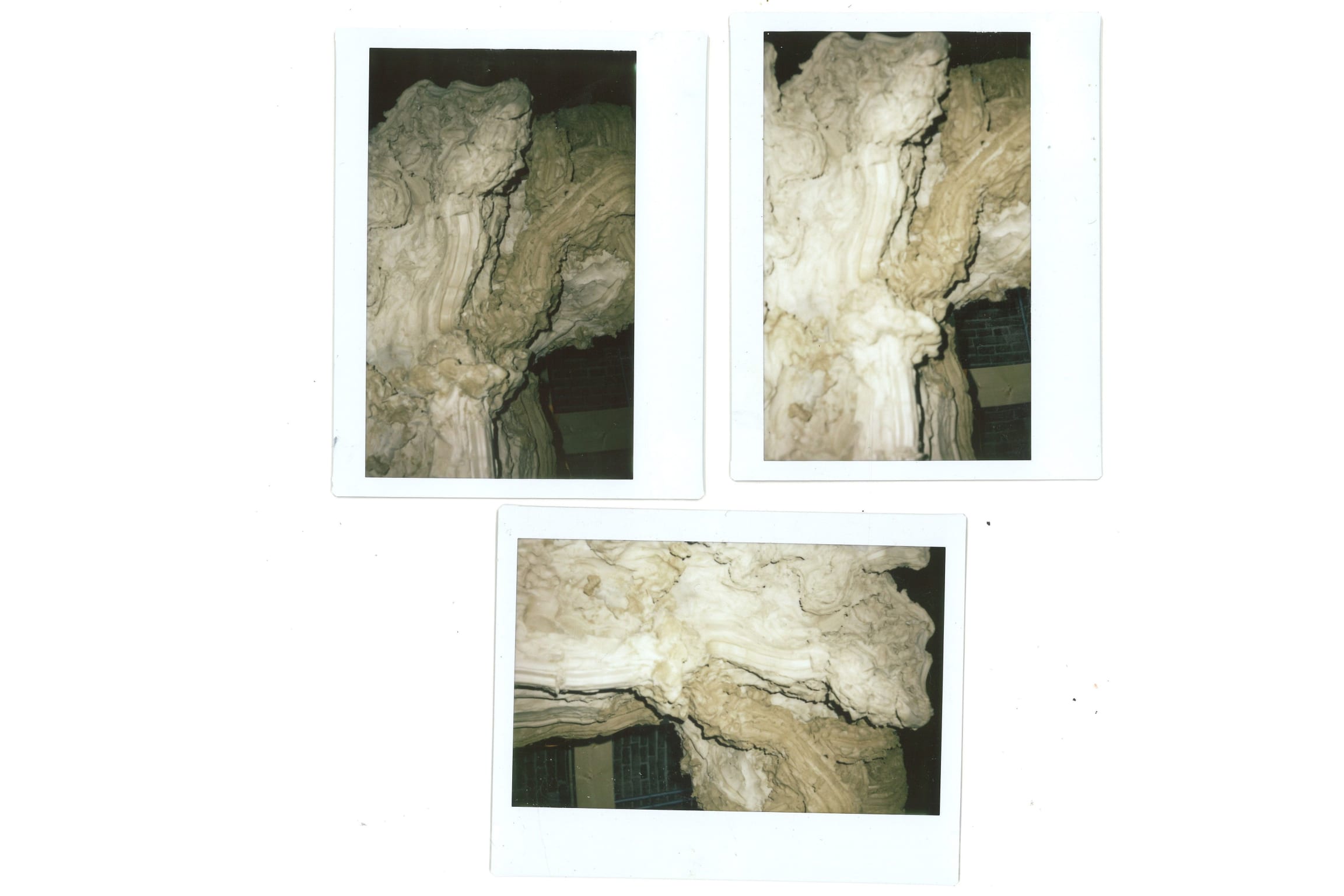
Krystel Geerts’ work features contrasts. Just when you think you recognise something, meaning slips away. From a distance, a sculpture appears to be made of clay, solid, heavy and architectural, but up close, proves to be a light plastic shell, revealing a tactile archive of touches, traces and states of mind. These opposites draw your attention, get you thinking and destabilise your gaze. Her work reflects a state or in-between phase.
This sense of being in transit is an intensely physical process. Geerts often begins with more than 800 kilograms of clay. She reuses clay from previous work, so that the material literally carries the memory of earlier forms. It is an exhausting process of building up and breaking down again. “I throw clay, strike it with my hands or use the soles of my feet to work it,” Geerts explains. You can see the imprints and traces of this ‘battle’. Her body functions as both compass and limit. “I listen to the signals of exhaustion from my body when a work becomes too large or too heavy.” As a starting point for the sculpture This weight stayed with me, she chose Bernini’s Ecstasy. “The sculpture is so beautiful,” Geerts notes. “I removed the woman and retained only the bed, which I set upright. I like to start with an existing volume as the foundation for my sculpture.” While the front now recalls a Baroque column or ornament, the back unexpectedly reveals a raw interior.
The deception in her sculpture is an invitation to keep looking. It makes you slow down, doubt and abandon any assumptions. This doubt is both optical and emotional. The disruption places you in a state of receptivity in which you no longer control, but allow. This ambiguity extends to your senses. The mould on display recalls a flowing slurry and emits an intense smell. It is as if you could sink into a river or a muddy landscape. It is beautiful and repulsive at once. It makes you aware of your own projections and shows that reality is complex and layered. Because what you see is neither one thing or the other, you stop naming and assigning meaning. In this elusiveness, an in-between space opens up in which meaning becomes fluid. It stuns you into silence, to a place where you no longer understand or analyse, but feel. Her sculptures are open, porous and in the process of creation, pointing towards a field of possibilities and nuances.
Her work presents the world as a fluid, multiple and constantly shifting whole in which meaning changes and depends on time and space. Geerts shows form as a temporary condition. Each phase of the work carries traces of what was and what is yet to be. What you see depends on perspective. Her work changes with every approach, as if continually reshaping itself under your gaze.
Krystel Geerts, Imprints, Fred & Ferry
Her sculptures are literally and figuratively in-between spaces: between inside and outside, tree and column, Baroque and mud, body and architecture. “I view the world as a landscape of folds,” Geerts says. “A map that continually rearranges itself under the influence of memory and emotion.” She is inspired by the philosopher Gilles Deleuze. Hollows, compressed or folded materials make traces of lived experience visible in her sculptures. This vision also continues in her glass work. She creates frozen movements on the wall or like a glitch before a mirror, distorting the familiar image and pointing the viewer towards the world’s complexity.
Beneath the physical intensity lies an emotional undercurrent that sustains everything. The title This weight stayed with me emphasises the personal nature of this process. It clarifies that the weight Geerts refers to is both material and emotional. The sculpture is a tactile archive of lived experience. You see remnants of states of mind that have found a temporary form. Her sculptures also serve as shells: protective yet open, places where the inner world touches the outer world. In this constant movement between form and dissolution, Geerts reveals a world that is not fixed but, like everyone who lives within it, perpetually in transit. Her work invites us to keep wandering within the fold, the in-between space and silence, where meaning continues takes shape again and again.

